The short answer
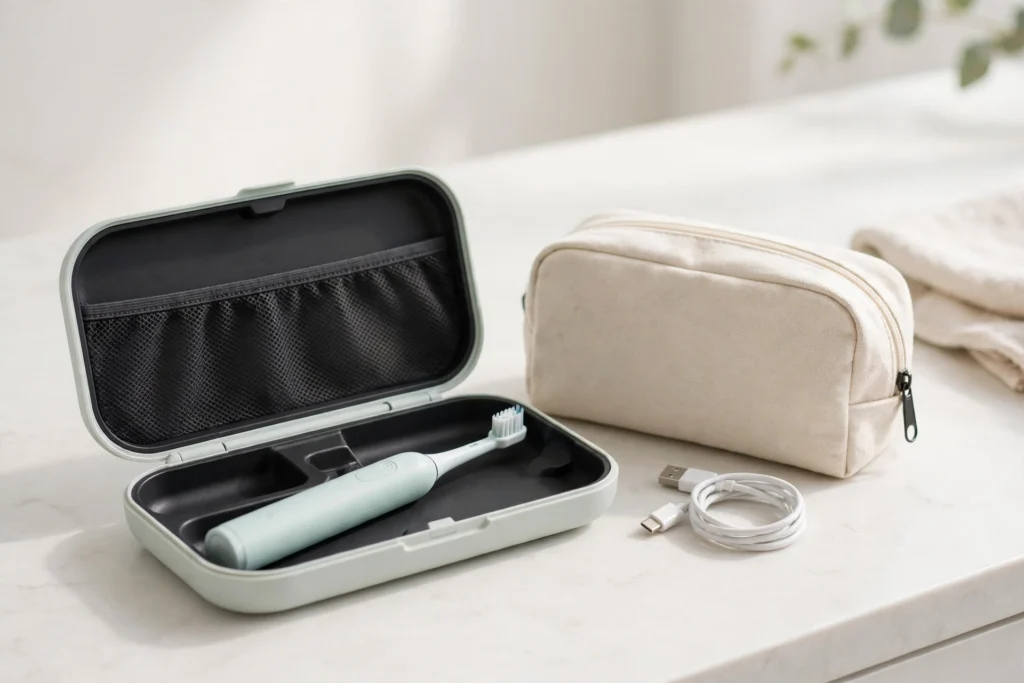
The best travel electric toothbrush is not the most powerful one. It is the one you will actually pack, that survives a bag without turning on, and that does not need its own charger, cable, and adapter. For most travellers that means three things: a battery that lasts the whole trip, charging that shares a cable you already carry, and a case that protects the brush head.
Our pick for most people is the Philips One by Sonicare (rechargeable). It is slim, it comes with a travel case, it charges over USB, and one charge lasts about 30 days — long enough that most trips need no charger at all. If you want the lightest possible kit, quip is the answer: about 1.3 oz, one AAA battery, three months of brushing, no charger to pack. If you want full-size cleaning power on the road, the Philips Sonicare 4100 is the strongest brush here, but you will need to buy a case for it.
Quick picks
| Brush | Best for | Typical price | Battery | Charging | Travel case |
|---|---|---|---|---|---|
| Philips One (rechargeable) | Best overall travel brush | ~$40 | 30 days | USB | Yes, included |
| quip Sonic | Lightest kit — no charger at all | ~$25–$40 | ~3 months (1 AAA) | AAA battery | Cover included |
| Philips Sonicare 4100 | Best full-power clean on the road | ~$35–$50 | 14 days | USB | No — buy separately |
| Oral-B iO Series 4 | Best premium travel brush | ~$80–$100 | 14 days | Magnetic (proprietary) | Yes, included |
| Aquasonic Black Series | Best value travel kit | ~$30 | 30 days | USB | Yes, included |
Prices move around — check the current price before you buy. Battery figures are the manufacturers’ figures for twice-daily, two-minute brushing; real life is usually a little shorter.
[Check price on Amazon — insert affiliate link]
How we chose
A travel brush has to clear four bars that a home brush does not. First, size and weight: it has to fit a toiletry bag without taking the space of a second brush. Second, battery: 14 days is the minimum for a normal holiday; 30 days or more means you can leave the charger at home. Third, charging: USB-C or USB charging that shares a phone cable beats a proprietary dock every time you travel abroad. Fourth, a case: a brush head rattling loose in a bag picks up dirt and can switch itself on — a real case, not a plastic sleeve, matters.
We also kept the cleaning bar from our other guides: every pick below is a real sonic or oscillating-rotating brush from an established brand, not a no-name motor in a slim handle. A travel brush that cleans badly is worse than a manual brush you actually use.
1. Philips One by Sonicare (rechargeable) — Best overall travel brush
The Philips One was designed as a travel-first brush, and it shows. The handle is slim and pen-like, the rechargeable version costs about $40 at Philips’ suggested retail price, and it comes with a magnetic snap-on travel case and a USB charging cord in the box. One charge lasts about 30 days, and it cleans with Sonicare’s sonic motion at 13,000 micro-vibrations per minute — gentler and less powerful than a full-size Sonicare at 31,000 strokes per minute, but a real sonic clean, not a vibrating manual brush.
The trade-off is power and features. There is one cleaning mode, no pressure sensor, and no quadrant timer beyond the standard two-minute timer. If you brush hard, you will not get a warning. For a week or two on the road, most people will not miss the extras; for everyday use at home, the Sonicare 4100 below is the stronger brush.
Watch out for the two versions, because shops mix them up. The rechargeable Philips One is about $40, charges over USB, and lasts about 30 days per charge. The battery Philips One is about $25, runs on one AAA battery for about 90 days, and never needs charging at all. Both include a travel case. If you hate charging cables, the AAA version is arguably the better travel brush; if you hate buying batteries, get the rechargeable one. Do not pay the rechargeable price for the battery version.
Good for: most travellers — weekends, holidays, and work trips up to a month.
Watch out for: one mode, no pressure sensor, and a gentler clean than a full-size Sonicare. Check which version you are buying before you pay.
[Check price on Amazon — insert affiliate link]
2. quip Sonic — Lightest kit, no charger at all
quip is the brush for people who count grams. The plastic starter kit is usually around $20–$25 and the metal version around $30–$40, the handle weighs about 1.3 oz, and it runs for about three months on a single AAA battery. There is no charger, no dock, and no cable to pack — the travel cover doubles as a stand and a mirror mount, so you can stick it to a hotel bathroom mirror.
The cover is the clever part and also the honest limit. It protects the head and holds the brush, but it is a cover, not a hard case: it will not protect the handle the way the Philips One’s case or the Aquasonic’s case will if your bag gets crushed. The clean is sonic, with a two-minute timer, and quip carries the ADA Seal — but it is a gentler clean than a Sonicare 4100 or an Oral-B, with one mode and no pressure sensor.
Running costs are simple and subscription-shaped: replacement heads are about $5 each on quip’s subscription, shipped every three months with a fresh AAA battery. That is cheap and easy to forget about, but it is a subscription — if you do not want one, you can buy heads separately, usually for a little more.
Good for: carry-on-only travel, backpacking, and anyone who wants the smallest possible toiletry kit.
Watch out for: a gentler clean than full-size brushes, no pressure sensor, and a cover rather than a hard case. Some owners report the brush stopping after months of use, so keep the receipt and warranty in mind.
[Check price on Amazon — insert affiliate link]
3. Philips Sonicare 4100 — Best full-power clean on the road
The 4100 is the best brush in this list at actually cleaning teeth — and the worst at travelling out of the box. It vibrates at up to 31,000 strokes per minute, has a genuine pressure sensor that pulses when you press too hard, a quadrant timer, and two intensity settings. It is the cheapest way into Philips’ real Sonicare technology, usually about $35–$50, and it is the brush we picked as the best overall budget brush in our companion guide.
The problem is the kit. The battery lasts about 14 days — fine for a normal holiday, not enough for a long trip without the charger — and the base model includes no travel case. The charger is now USB-based, which is a real improvement over Philips’ old proprietary cradle, but you will need a third-party case, and a loose 4100 in a bag is exactly the brush most likely to switch itself on.
So buy it for travel only if cleaning power matters more to you than packing light. Charge it fully before you leave, pack the USB charger for anything over two weeks, and spend a few dollars on a hard case. If you travel every week, the Philips One above will make your life easier; if you travel twice a year and want your home brush to come with you, the 4100 is the one to take.
Good for: travellers who want their home brush, at full power, on the road.
Watch out for: no travel case included, and a 14-day battery — pack the charger for longer trips. Replacement heads are the most expensive in this list, about $25–$30 for a 3-pack.
[Check price on Amazon — insert affiliate link]
4. Oral-B iO Series 4 — Best premium travel brush
The iO Series 4 is the premium pick: a full-featured Oral-B with oscillating-rotating cleaning, a smart pressure sensor, an app, and a travel case in the box, usually about $80–$100. The battery lasts about 14 days, and the case protects the brush properly. If you already use an Oral-B at home and like the small round head, this is the most comfortable way to take that clean travelling.
The catch is the charger. Oral-B still uses a proprietary magnetic charger, not USB-C. It is compact, but it is one more thing to pack, one more thing to lose, and one more thing that cannot share a cable with your phone. That single fact is why Sonicare wins the travel comparison in most head-to-head reviews: Philips’ premium cases charge over USB-C, while Oral-B’s do not.
Fourteen days is also the honest limit. For a two-week holiday it is enough; for a three-week trip, pack the charger. And at $80–$100, this is a brush to buy because you want the iO clean, not because it is the cheapest way to brush on holiday — the Philips One does the travel job for half the price.
Good for: Oral-B users who want their usual clean, with a case, on the road.
Watch out for: proprietary magnetic charger, 14-day battery, and a premium price for travel features you can get cheaper elsewhere.
[Check price on Amazon — insert affiliate link]
5. Aquasonic Black Series — Best value travel kit
The Aquasonic is the best deal measured by what comes in the box: the brush, a travel case, and eight brush heads — about two years’ worth — for around $30. It is ADA Accepted, has four modes (Clean, Soft, Whiten, Massage), and a 30-day battery. For a traveller, the arithmetic is simple: brush, case, and two years of heads in one purchase, with a battery long enough to leave the charger at home on most trips.
The clean is a solid sonic clean, comparable to the Fairywill P11 from our budget guide, and the included heads are soft enough for most people. What it does not have is a pressure sensor — use a light grip and let the brush do the work — and Aquasonic is a smaller company than Philips or Oral-B, so long-term head availability is less certain, though the eight included heads buy you two years to find out.
The case is a real hard case, not a sleeve, which is what puts this ahead of the quip for checked luggage and rough bags. If your bag gets thrown around, this is the $30 kit most likely to arrive intact.
Good for: anyone who wants a complete travel kit in one purchase and hates reordering heads.
Watch out for: no pressure sensor; head availability beyond the included eight is less certain than Philips or Oral-B.
[Check price on Amazon — insert affiliate link]
What to pack: the 30-second checklist
- Brush + head, in its case. Never pack a bare brush head loose in a bag. If your brush has no case, buy a hard case before the trip, not at the airport.
- Charger — only if the trip is longer than the battery. A 30-day brush needs no charger for a two-week holiday. A 14-day brush does for anything over two weeks. A AAA brush needs a spare AAA battery, not a charger.
- One spare head. Heads are small, light, and easy to lose or damage in a bag. Pack one, sealed.
- The cable you already carry. If your brush charges over USB-C, use your phone cable. If it needs a proprietary charger, pack that charger in the same pouch as the brush so they do not get separated.
- Toothpaste, floss, and interdental brushes. A travel brush does not replace floss — no electric brush cleans between teeth properly on its own.
Charging abroad and going through security
Electric toothbrushes are allowed in both carry-on and checked bags — there is no TSA restriction on them, and the same is true for most other countries’ security checks. Keep the brush in your carry-on if you can: it is less likely to be crushed, and you can use it on a long layover.
Charging is where trips go wrong. A brush that charges over USB-C or USB sidesteps voltage entirely: any phone charger, laptop port, or power bank will do, anywhere in the world. A brush with a proprietary wall-plug charger needs the right plug adapter, and you should check the voltage range printed on the charger (most modern chargers are 100–240V, but check yours before you travel). If you are choosing between two otherwise equal brushes for international travel, pick the USB-C one.
A note on batteries: a AAA-powered brush like quip avoids charging altogether, but do not pack loose lithium batteries in checked luggage — follow your airline’s rules for spares, and keep spares in your carry-on.
How to choose in 30 seconds
- You travel often and want the easiest kit: Philips One (rechargeable). Slim, cased, USB charging, 30-day battery.
- You travel light and hate chargers: quip. About 1.3 oz, three months on one AAA, no cable at all.
- You want full-size cleaning power: Philips Sonicare 4100 — but buy a hard case and pack the USB charger for trips over two weeks.
- You already love Oral-B and want premium features: Oral-B iO Series 4. Accept the proprietary charger as the price of that clean.
- You want everything in one cheap box: Aquasonic Black Series. Brush, hard case, and eight heads for about $30.
Safety First
An electric toothbrush is a tool, not a treatment. A few things worth knowing before you buy:
- Don’t press hard. The most common mistake with an electric brush is using manual-brush pressure. Let the bristles do the work, guide the brush slowly along the gumline, and let the pressure sensor (if yours has one) do its job.
- Replace the head every three months, or sooner if the bristles splay — and after any trip where the head was stored damp in a closed case for days. A worn head cleans worse and can irritate gums.
- Let the head dry. A brush head sealed damp in a travel case is a good place for bacteria to grow. Open the case when you arrive, rinse the head, and let it air-dry before you close it again.
- It doesn’t replace floss. No electric brush, budget or premium, cleans between teeth properly. Floss or interdental brushes are still needed daily, at home and on the road.
- See a dentist if: your gums bleed for more than two weeks after switching, you have persistent pain, a tooth feels loose, or you notice gum recession. A brush can’t fix gum disease, and bleeding that doesn’t settle is worth a checkup — not a different brush.
- Kids under 8 should use a brush made for their age and size, with adult supervision. Our kids’ guides cover this in detail.
Frequently asked questions
Can I take an electric toothbrush on a plane?
Yes. Electric toothbrushes are allowed in both carry-on and checked bags. Carry-on is better: the brush is less likely to be crushed or switched on in transit, and you can use it on a long layover.
Do I need a travel case, or will any pouch do?
A real case is worth it. A pouch stops dirt but does not stop the brush switching on in your bag, and a switched-on brush can drain its battery and vibrate against everything else in the bag. A hard case protects the head and the handle.
USB-C or a proprietary charger — does it matter?
For travel, yes. USB-C means one cable for your phone, laptop, and brush. A proprietary charger means one more thing to pack, lose, and replace — and it may need a plug adapter abroad. If two brushes are otherwise equal, pick the USB-C one.
How long should the battery last for travel?
Fourteen days covers a normal holiday. Thirty days or more means you can leave the charger at home. If your brush lasts under two weeks, charge it fully before you leave and pack the charger.
Is the Philips One powerful enough, or is it just a travel toy?
It is a real sonic brush at 13,000 micro-vibrations per minute — less powerful than a full-size Sonicare at 31,000 strokes per minute, but a genuine step up from manual brushing. For a week or two on the road it is enough. For everyday use at home, the Sonicare 4100 is the stronger brush.
Sonic or oscillating — which is better for travel?
Neither is proven better overall. Oscillating-rotating (Oral-B) has the stronger research record for plaque removal; sonic (Philips, quip, Aquasonic) is usually the more comfortable, quieter choice. For travel, the deciding factors are battery, charging, and the case — not the cleaning motion.
Bottom line
If you want one answer: buy the Philips One (rechargeable) if you want the easiest travel kit, or quip if you want the lightest one and never want to pack a charger. If cleaning power matters more than packing light, take the Philips Sonicare 4100 — and buy it a hard case first.
The most expensive mistake in travel brushing isn’t buying the wrong brush. It’s packing a good brush with no case, a dead battery, and the wrong charger — and ending up brushing with the hotel’s free manual brush instead.
Related: Best Budget Electric Toothbrush (2026): Good Cleaning Under $50