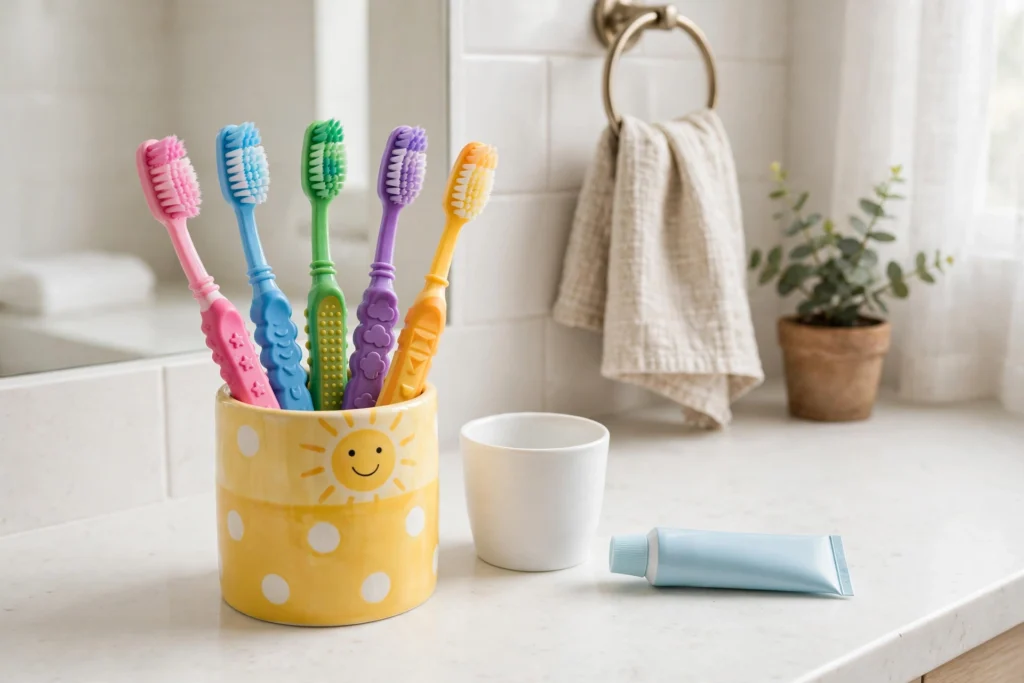
A manual toothbrush is the least exciting thing in a child’s bathroom, and that is exactly why it deserves a careful look. It is the brush a child uses for their very first teeth, the brush that travels in a school bag without a charger, and the brush that costs so little that replacing it on time never feels like a waste. An electric brush can clean well, but it cannot do any of that. For children under 3, a manual brush is not the budget option — it is the recommended one.
This guide picks manual brushes only, on public label and packaging information, not on laboratory tests we did not run. It does not invent ratings. The rule that runs through every pick is the same one pediatric dentists repeat: soft bristles, a head small enough for the child’s mouth, and a handle the child — or the parent helping them — can actually hold. Everything else is secondary.
Quick Picks
| Pick | Best for | Ages | Bristles |
|---|---|---|---|
| Jordan Step 1–4 | An age-matched system that grows with your child | 0–2, 3–5, 6–9, 9–12 | Extra soft to soft, by step |
| Colgate Kids | The easy-to-find brush in most stores | 2+ (check the variant label) | Soft |
| Oral-B Kids Manual | A widely available value pick | 3+ (check the variant label) | Soft |
| Radius Totz | A first brush for toddlers | 18 months+ | Extra soft |
| MAM Learn to Brush Set | Parent-guided first brushing | 5 months+ | Extra soft |
[Check price on Amazon — insert affiliate link]
The Age Rule First: Match the Brush to the Mouth, Not the Birthday Cake
A brush that is right for a 9-year-old is wrong for a 2-year-old, and the reason is physical, not cosmetic. A head that is too big cannot reach the back molars — there is simply not enough room between the teeth and the jaw — and a handle that is too long or too thin slips out of a small hand. Age bands on the packaging exist because mouths grow in predictable stages, and they are the single most useful thing on the box.
- First teeth to age 2: a very small head, extra-soft bristles, and a short neck. At this age the parent does most of the brushing, so the handle should suit an adult hand as well as a baby’s grip. Start brushing as soon as the first tooth appears, with a rice-grain smear of fluoride toothpaste until age 3.
- Ages 3–5: a small head with soft bristles, and a handle a child can hold on their own. The child will want to try brushing alone; let them, then finish the job yourself. Toothpaste moves up to a pea-sized amount after age 3.
- Ages 6–9: a slightly larger head for a growing mouth and mixed baby and permanent teeth. This is the age when a child starts losing baby teeth, so a brush that can clean around wobbly teeth and new molars without hurting matters more than any character on the handle.
- Ages 9–12: a near-adult head size with soft bristles, as the mouth approaches adult size. Around age 10, many children can move to an adult brush, but there is no rush — a kids’ brush that still fits comfortably is better than an adult brush that does not.
Supervision is the other half of the age rule. Pediatric dentists generally recommend that a parent supervise brushing until a child has the dexterity to do it properly — roughly age 7 or 8. A manual brush does not time the brushing or coach the technique, so for a young child the parent is the timer and the coach. That is not a flaw in the brush; it is how manual brushing works, and it is why the cheapest brush in the house still needs an adult in the room.
What to Look for Besides the Character on the Handle
Soft bristles, always. The American Dental Association recommends soft bristles, and for children that is not a suggestion — it is the filter. Soft bristles clean just as well as firmer ones and do not damage delicate gums or enamel. If a brush is not labeled soft or extra soft, skip it for a child. Medium or hard bristles have no place in a child’s mouth.
A head that fits. Hold the head against your child’s mouth, not against the picture on the box. It should cover about two teeth at a time and reach the back molars without forcing the cheek open. If your child gags, cannot close their mouth around it, or can only chew on it, the head is too big.
A handle your child can hold — and you can hold too. A thick, slightly textured handle with a non-slip grip suits small hands better than a slim adult-style handle. For babies and toddlers, look for a handle a parent can grip at the same time, or a short neck that stops the brush going too far into the mouth. A brush your child drops every ten seconds is a brush they will not use.
Rounded bristle tips. Bristle ends should feel smooth, not sharp or frayed, when you run a finger across them. Rounded tips are gentler on gums, and they are worth checking when you open a new pack, because a damaged brush straight out of the packet should go back, not into a child’s mouth.
The seal as a tie-breaker. The American Dental Association Seal of Acceptance means a product has met the ADA’s criteria for safety and effectiveness for its stated purpose. It is a reasonable tie-breaker between two otherwise similar brushes, not a guarantee that a product suits your child, and its absence does not automatically mean a product is unsafe.
Skip the U-shaped novelty brush. Dentists do not recommend U-shaped toothbrushes as a primary brush: the U-shape cannot adapt to different mouth sizes and does not clean along the gumline effectively, and children tend to just bite and chew on them. A standard small-headed manual brush does the job the U-shape promises and does not deliver.
Manual vs. Electric: An Honest Comparison
An electric brush removes plaque well and its timer helps children brush for the full two minutes, and for a child aged 3 or older who will actually use one, it is a good choice — our electric-toothbrush-for-kids guide covers that in detail. But a manual brush wins in four places that matter for families:
- Under 3, manual is the default. Most electric brushes are not designed for toddlers, and a small manual brush is what pediatric guidance points to for first teeth.
- Travel and second homes. No charger, no dock, no battery to die. A manual brush goes in a bag and works.
- Cost of replacing on time. A manual brush costs little enough that replacing it every 3 to 4 months — or sooner if the bristles splay — never feels wasteful. An electric head that costs several times more is easier to keep using past its best.
- Technique. A manual brush teaches a child how to move a brush around their own mouth. That skill transfers to every brush they will ever use.
The honest limit is the other way too: a manual brush has no timer, so a child who rushes will under-brush. The fix is free — a parent counting, a two-minute song, or a sand timer on the sink — but it does need a parent. If nobody is supervising and the child will not brush for two minutes with a manual brush, an electric with a built-in timer may be the better practical choice.
The Picks in Detail
1. Jordan Step 1–4
Jordan’s Step system is the pick for parents who want the age question answered for them. Step 1 covers ages 0–2 with extra-soft bristles, a short neck, and a soft biting ring for gums; Step 2 covers ages 3–5 with a round head for cleaning baby teeth; Step 3 covers ages 6–9, with a design aimed at mixed baby and permanent teeth; and Step 4 covers ages 9–12. The handle is shaped to fit both a child’s hand and a parent’s hand, which matters most at Step 1, when the parent is doing the brushing. Buying the next step when your child outgrows the last one is a simple, memorable routine — no re-researching every few months. Check the step number on the pack you buy, because the steps look similar and the age band is the whole point.
[Check price on Amazon — insert affiliate link]
2. Colgate Kids
Colgate Kids is the easy-to-find option, and availability matters when a brush needs replacing on a Sunday evening and the only shop open is the supermarket. It is a soft-bristled manual brush with a small head and a child-sized handle, in character designs children tend to accept, with variants labeled by age — check the variant label rather than assuming every Colgate Kids brush fits every age. Its strength is consistency: the same product in most stores, a mild price, and a familiar routine. If your child is particular about change, that consistency is a genuine advantage, and at this price, keeping a spare in the travel bag costs almost nothing.
[Check price on Amazon — insert affiliate link]
3. Oral-B Kids Manual
Oral-B’s kids’ manual brush is the value pick. It pairs a small round head with soft bristles and a handle sized for children’s hands, and it is sold widely, often in multi-packs that bring the per-brush cost down to very little — which is exactly what you want when the rule is to replace the brush every few months. The round head is a small but real advantage for reaching back teeth in a small mouth. As with Colgate, check the age label on the variant you buy: Oral-B sells kids’ manual brushes in more than one age band, and the band on the pack is what decides whether it fits your child.
[Check price on Amazon — insert affiliate link]
4. Radius Totz
Radius Totz is the first-brush pick for toddlers, from around 18 months. It has extra-soft bristles, a small head, and a wide, easy-to-grip handle that a toddler can hold without it twisting away — the handle is the feature here, as much as the bristles. The bristles are BPA-free, and the brush is designed for the age when a child is learning to hold a brush at all, not just learning to brush. Its limit is also its point: a toddler will outgrow it, and that is fine. A first brush should be outgrown, not kept for years. Buy it for the stage it serves, and move on to a 3–5 brush when your child does.
[Check price on Amazon — insert affiliate link]
5. MAM Learn to Brush Set
MAM’s Learn to Brush Set is the pick for the very first brushing attempts, from around 5 months. It comes with a long handle a parent can hold together with the baby, plus a shorter handle for the baby to hold alone, and a removable safety shield that helps keep the brush from going too far into the mouth. The bristles are extra soft, and the set is designed around the reality that at this age the parent is the brusher and the baby is the learner. It is a short-lived purchase — a few months, not a year — but for a family starting from the first tooth, it removes the two worries that stop parents beginning: hurting the baby’s gums, and the brush going in too far.
[Check price on Amazon — insert affiliate link]
Replacement Cadence: The Cheapest Habit in Oral Care
The American Dental Association recommends replacing a toothbrush every 3 to 4 months, or sooner if the bristles become frayed — and children wear brushes out faster than adults do, because they chew on them. Check the bristles monthly: if they are splayed, bent, or matted, the brush is done, however new it looks. Replace the brush after your child has been sick, too, so a cold does not get a second chance.
Make replacement automatic rather than memorable. Buy multi-packs and keep the next brush in the cupboard, or set a phone reminder for the day you open a new brush. Four brushes a year per child is a small cost for a tool that does its job only while its bristles are straight. A worn brush does not clean less by a little — splayed bristles cannot reach between teeth or along the gumline at all.
Store the brush upright so it can air dry, rinse it thoroughly after use, and keep it from touching other family members’ brushes. Skip the sealed travel case except when traveling: a closed, damp container encourages microbial growth, and a brush that never dries is a brush that should have been replaced sooner.
How to Build the Routine
Brush twice a day for two minutes, with a rice-grain smear of fluoride toothpaste until age 3 and a pea-sized amount after that. For a young child, brush for them first, then let them have a turn — the order matters, because a child who brushes first and is then “corrected” by a parent learns that brushing is a test. Let them practice, then finish the job yourself, checking the back molars and the gumline.
Supervise until about age 7 or 8, even if your child insists they can do it alone. The test is not whether they can hold the brush; it is whether they can reach every surface, including the backs of the front teeth and the chewing surfaces of the molars, without being reminded. Most children cannot do that reliably until that age, and a manual brush gives them no reminder when they skip a spot.
If your child hates brushing, change the brush before you change the routine. A new color, a character they chose themselves, or a handle that fits their hand better can turn a chore into a choice. Let them pick from two acceptable options — both soft, both the right size — rather than from the whole shelf. And keep the pressure light: a soft brush pressed hard cleans worse and hurts more than a soft brush used gently.
Safety First: When to See a Dentist
A toothbrush cannot fix a problem that needs a dentist:
- Brown or black spots, visible holes, or pain when eating or drinking.
- Gums that bleed regularly, swell, or stay red despite gentle brushing.
- White spots on teeth that are new or spreading, which can be an early sign of decay or fluorosis.
- A tooth that is chipped, knocked loose, or injured in a fall.
- Persistent bad breath that does not improve with brushing, tongue cleaning, and rinsing.
- Difficulty opening the mouth, swelling of the face, or fever with tooth pain — seek care promptly.
Also, check the brush itself: loose or missing bristles, a cracked handle, or a head that wobbles are all reasons to throw it away immediately, not at the next scheduled replacement. Never share a toothbrush between children, and keep each child’s brush separate so a worn one is not picked up by mistake.
The Bottom Line
For most families, the best manual toothbrush for kids is a soft-bristled brush with a head small enough for the child’s mouth, in the right age band, replaced every 3 to 4 months — with a parent supervising until about age 7 or 8. The Jordan Step system is the simplest way to get the age band right at every stage; Colgate Kids and Oral-B Kids are the easy, inexpensive brushes to keep in the house and the travel bag; and Radius Totz and the MAM Learn to Brush Set cover the first teeth, when the parent is doing most of the work. Pick the one that fits your child’s age and hand, let them choose the color, and replace it on time. The brush is cheap. The habit is what costs attention — and it is the habit, not the brush, that protects the teeth.