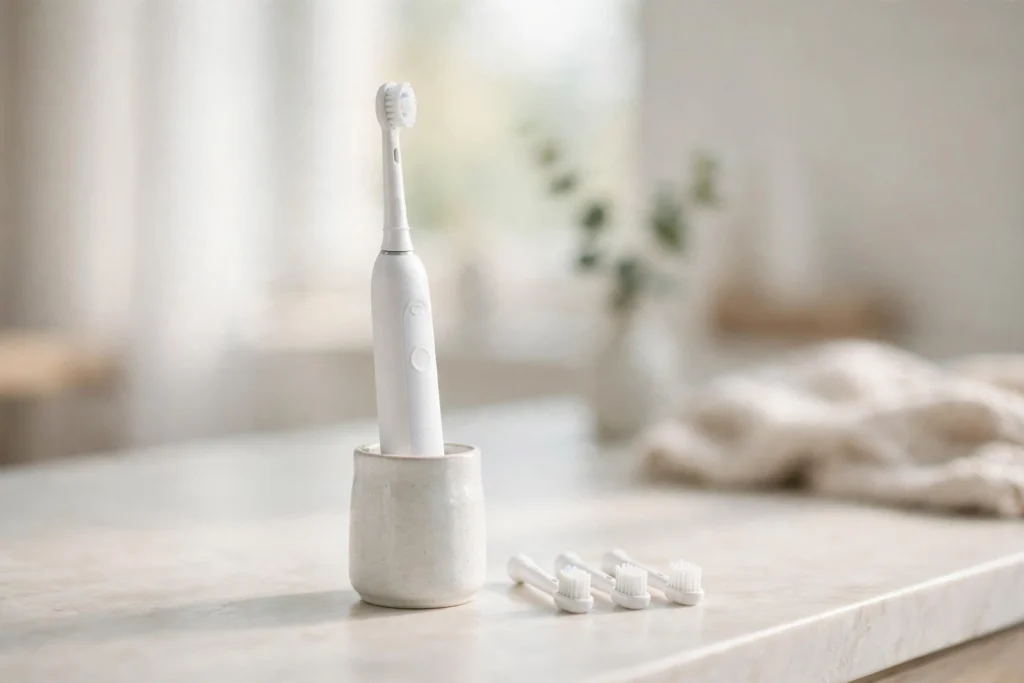
The short answer
Yes, a cheap electric toothbrush can clean as well as a $150 one — because the cleaning itself is done by the same basic motion. What you pay for in a premium brush is mostly everything around the cleaning: a smarter pressure sensor, more modes, longer battery life, a travel case, and an app. If you just want cleaner teeth and healthier gums, $25–$50 buys you a genuinely good brush. The trick is knowing where the corners were cut, and what the brush will actually cost you over two years once you factor in replacement heads.
We tested the logic, not the marketing: every pick below is a real brush from a major brand (or a well-established budget brand), with a pressure sensor or a genuinely useful mode where it matters, and a replacement-head cost that doesn’t quietly double the price.
Quick picks
| Brush | Best for | Typical price | Battery | Pressure sensor |
|---|---|---|---|---|
| Philips Sonicare 4100 | Best overall budget brush | ~$50 | 14 days | Yes |
| Oral-B Pro 1000 | Best plaque removal per dollar | ~$50 | 7 days | Yes |
| Fairywill P11 | Cheapest good sonic clean | ~$25 | 30 days | No (vibration alert) |
| Aquasonic Black Series | Best value in the box | ~$30 | 30 days | No |
| Oral-B Vitality FlossAction | Cheapest Oral-B that works | ~$28 | 5 days | No |
Prices move around — check the current price before you buy. The ranking below is by cleaning quality and total cost, not by sticker price alone.
[Check price on Amazon — insert affiliate link]
How we chose
A budget brush has to clear three bars. First, it must clean at least as well as a manual brush — that rules out no-name brushes with weak motors and unbranded heads. Second, it must not punish you later: replacement heads are where cheap brushes often get expensive, so we priced two years of heads into every pick. Third, it must be safe to use every day: a pressure sensor is ideal, but a brush without one is acceptable if its bristles are soft and its power is not aggressive. We did not consider brushes with an app, UV sanitizers, or other extras — those are premium features, and this article is about what you can skip.
1. Philips Sonicare 4100 — Best overall budget brush
The 4100 is the cheapest way into Philips’ real Sonicare technology, and it is the budget pick we would buy first. It vibrates at up to 31,000 brush strokes per minute, the same sonic motion as Philips’ expensive models, and it has a genuine pressure sensor that buzzes when you press too hard — the single most useful safety feature on any electric brush, and rare under $50.
It has two intensity settings (low and high) rather than the five or six modes of the premium models, and the battery lasts about two weeks rather than three. Neither matters much in practice: most people use one mode every day, and two weeks is plenty between charges. It ships with the C2 Optimal Plaque Control head, and it accepts the full Sonicare head range, so you are not locked into a cheap head ecosystem.
The real cost is the heads. A 3-pack of C2 heads typically runs about $25–$30, and you should replace the head every three months, so budget roughly $30–$40 a year. Over two years, the 4100 costs about $110–$120 all-in — still far less than a premium Sonicare, and you get the same core clean.
Good for: anyone switching from manual who wants the safest, simplest upgrade.
Watch out for: replacement heads are the most expensive in this list; buy them in multi-packs.
[Check price on Amazon — insert affiliate link]
2. Oral-B Pro 1000 — Best plaque removal per dollar
The Pro 1000 is the budget pick with the strongest evidence behind it. It uses Oral-B’s oscillating-rotating motion — a small round head that spins back and forth while pulsing — and that specific motion is the one with the best research record: a Cochrane review found rotation-oscillation powered brushes reduce plaque and gingivitis more than manual brushing in the short term. The Pro 1000 is the cheapest Oral-B that delivers that motion with a pressure sensor.
It has one cleaning mode (Daily Clean) and a 7-day battery, both shorter than the Philips 4100. In return you get the CrossAction head, which is genuinely good at reaching along the gumline, and a pressure sensor that stops the pulsations when you press too hard — a clear, physical warning that is hard to ignore.
Heads are cheaper than Philips’: a 3-pack of CrossAction heads is usually around $18–$22, so roughly $20–$25 a year. Two-year total: about $90–$95. If your main problem is plaque buildup or early gum bleeding, this is the pick.
Good for: plaque and gumline cleaning on a budget; people who like the feel of a small round head.
Watch out for: the 7-day battery is the weakest here; charge it every Sunday and it is a non-issue.
[Check price on Amazon — insert affiliate link]
3. Fairywill P11 — Cheapest good sonic clean
The P11 is the brush for people who want to spend as little as possible without buying junk. It is a sonic brush with five modes (Clean, Soft, White, Massage, Sensitive), a 30-day battery, and a price that usually sits around $25. It is the longest-lasting battery in this list by a wide margin.
What it does not have is a true pressure sensor — it vibrates to warn you instead of cutting power — and its heads are softer and smaller than Philips’ or Oral-B’s. The clean is good, but it is a gentler clean: if you have heavy tartar buildup, the Pro 1000 will do more per stroke.
Where it wins is the running cost. Fairywill heads are inexpensive — a pack of four or eight costs about $10 — so a year of heads is roughly $10. Two-year total: about $45. That is less than the Sonicare 4100 costs in heads alone.
Good for: students, second bathrooms, travel, or anyone who wants the cheapest brush that is still a real sonic brush.
Watch out for: no true pressure sensor — use a light grip and let the brush do the work.
[Check price on Amazon — insert affiliate link]
4. Aquasonic Black Series — Best value in the box
The Aquasonic Black Series is the best deal measured by what comes in the box: the brush, a travel case, and eight DuPont brush heads — two years’ worth — for around $30. It is ADA Accepted, which is unusual at this price, and it has four modes (Clean, Soft, Whiten, Massage) with a 30-day battery.
The clean is a solid sonic clean, comparable to the Fairywill P11, and the included heads are soft enough for most people. The pressure sensor is absent, as on the other sub-$30 picks, so the same light-grip advice applies. The main trade-off is the brand: Aquasonic is a smaller company than Philips or Oral-B, so long-term head availability is less certain — though the eight included heads buy you two years to find out.
Two-year total: about $46, since you may not need to buy a single head in that time.
Good for: anyone who wants everything in one purchase and hates reordering heads.
Watch out for: no pressure sensor; head availability beyond the included eight is less certain than Philips or Oral-B.
[Check price on Amazon — insert affiliate link]
5. Oral-B Vitality FlossAction — Cheapest Oral-B that works
The Vitality is the simplest electric brush Oral-B makes, and the cheapest way to get the oscillating-rotating motion. It has one mode, a 2-minute timer, and a 5-day battery. It has no pressure sensor and no extra modes, and the handle feels lighter and cheaper than the Pro 1000.
Why include it? Because it is the floor. If your budget is truly under $30 and you want the Oral-B motion with the cheapest possible entry point, this is it — and it is still a real improvement over manual brushing. But the gap to the Pro 1000 is small in price (about $20) and real in value: the pressure sensor alone is worth that difference for most people, and the Pro 1000’s battery lasts longer. Buy the Vitality only if the extra $20 genuinely matters.
Two-year total: about $68, using the same inexpensive CrossAction heads as the Pro 1000.
Good for: a first electric brush on the tightest budget, or a spare for travel.
Watch out for: no pressure sensor and the shortest battery in this list.
[Check price on Amazon — insert affiliate link]
What you actually give up vs. premium brushes
| Feature | Budget ($25–$50) | Premium ($100+) | Does it matter? |
|---|---|---|---|
| Cleaning motion | Same core motion | Same core motion | No — this is the point |
| Pressure sensor | Basic, or absent | Smart, with app feedback | Yes, if you brush hard |
| Modes | 1–5 | 5–7, plus gum care and whitening | Rarely — most people use one |
| Battery | 5–30 days | 2–4 weeks | Only if you travel |
| Travel case | Sometimes included | Usually included | Only if you travel |
| App and tracking | None | Yes | No, for most people |
| Replacement head cost | $10–$40/year | $30–$60/year | Yes — see below |
The honest summary: you give up convenience and feedback, not cleaning. A $50 brush does not clean half as well as a $100 brush. It cleans about as well, and tells you less about it.
The real price: two years of heads
The sticker price is not the price. Here is what each pick costs over two years, brush plus eight replacement heads (one every three months):
| Brush | Brush | Heads (2 years) | Total |
|---|---|---|---|
| Fairywill P11 | ~$25 | ~$20 | ~$45 |
| Aquasonic Black Series | ~$30 | ~$16 | ~$46 |
| Oral-B Vitality | ~$28 | ~$40 | ~$68 |
| Oral-B Pro 1000 | ~$50 | ~$40–$45 | ~$90–$95 |
| Philips Sonicare 4100 | ~$50 | ~$60–$70 | ~$110–$120 |
Two things stand out. First, the cheapest brush to buy is also the cheapest brush to own — the Fairywill and Aquasonic win on total cost by a wide margin. Second, the Philips 4100’s heads cost more than some whole brushes. If you choose Philips, buy heads in multi-packs and watch for sales; that is where the money goes.
[Check price on Amazon — insert affiliate link]
How to choose in 30 seconds
- You brush too hard, or your gums bleed: Philips Sonicare 4100 or Oral-B Pro 1000. The pressure sensor is worth the extra money.
- You want the lowest total cost: Fairywill P11 or Aquasonic Black Series. Both are under $50 for two years, all-in.
- You have heavy plaque or tartar buildup: Oral-B Pro 1000. The oscillating-rotating motion has the best evidence for plaque removal.
- You travel a lot: Fairywill P11 or Aquasonic Black Series. Both have 30-day batteries and the Aquasonic includes a case.
- You just want the cheapest Oral-B: Vitality — but check the Pro 1000 first, since the price gap is small and the pressure sensor is worth it.
Safety First
An electric toothbrush is a tool, not a treatment. A few things worth knowing before you buy:
- Don’t press hard. The most common mistake with an electric brush is using manual-brush pressure. Let the bristles do the work, guide the brush slowly along the gumline, and let the pressure sensor (if yours has one) do its job.
- Replace the head every three months, or sooner if the bristles splay. A worn head cleans worse and can irritate gums — and it wipes out the savings of a budget brush.
- It doesn’t replace floss. No electric brush, budget or premium, cleans between teeth properly. Floss or interdental brushes are still needed daily.
- See a dentist if: your gums bleed for more than two weeks after switching, you have persistent pain, a tooth feels loose, or you notice gum recession. A brush can’t fix gum disease, and bleeding that doesn’t settle is worth a checkup — not a different brush.
- Kids under 8 should use a brush made for their age and size, with adult supervision. Our kids’ guides cover this in detail.
Frequently asked questions
Is a $25 electric toothbrush actually better than a manual one?
Yes, if it is a real sonic or oscillating-rotating brush from an established brand. The advantage comes from the motion — thousands of strokes per minute, applied consistently — which is hard to match by hand. A $25 brush from Philips, Oral-B, Fairywill, or Aquasonic clears that bar. A $10 no-name brush usually does not.
Do I need a pressure sensor?
If you brush hard or your gums bleed, yes — it is the most useful feature on this list, and the main reason to spend $50 instead of $25. If you naturally brush gently, you can skip it and save the money.
Sonic or oscillating — which is better?
For plaque removal, oscillating-rotating (Oral-B) has the stronger research record. For gentle, comfortable cleaning, especially with sensitive gums, sonic (Philips, Fairywill, Aquasonic) is usually the more comfortable choice. Neither is proven better overall, and the difference between them is smaller than the difference between any electric brush and a manual one.
How long do budget electric toothbrushes last?
Typically two to three years with normal use. The battery is usually what gives out first. Budget brushes are not designed to be repaired, so factor that into the total cost — but even replacing a $25 brush every two years is still cheaper than one premium brush.
Bottom line
If you want one answer: buy the Philips Sonicare 4100 if you can spend $50 and want the safest all-round brush, or the Oral-B Pro 1000 if plaque is your main problem. If money is tight, the Fairywill P11 at around $25 is a real sonic brush that costs about $45 over two years, heads included — and that is hard to beat.
The most expensive mistake in budget brushing isn’t buying a cheap brush. It’s buying a cheap brush and then paying premium prices for its heads. Check the head price before you check the brush price.